
Worth County Civil Docket Searches
Civil cases from Worth Superior and State Court flow through the Georgia Courts E-Access directory. They land in PeachCourt. The vendor makes you register an account first. Its public screen offers sign-in and registration controls only. Case filters and current document prices stay behind the login. The GSCCCA county and clerk-name search, meanwhile, only locates the clerk's office. It does not search civil dockets at all. Before searching, gather the court, party name, approximate filing date, case number if known, and the type of record you need.
- Select Worth Superior or Worth State from E-Access and continue to PeachCourt.
- Sign in through the official page and search with the authenticated controls.
- Use the Tifton Worth calendar only for a hearing or trial setting.
- Contact the separate Magistrate or Probate office when the case belongs there.
- Ask Room 13 for the register, pleading, order, judgment, older file, or certified copy.
When a search comes back empty, check venue, spelling, date range, and your access status. An empty result is never proof that no Worth County civil docket exists.
Worth Civil Portal Versus Directory
PeachCourt and the GSCCCA clerk directory do different jobs. PeachCourt is the account-required e-access route for covered Worth County civil court dockets. The directory simply identifies Marcia Kimbro Inman and her office, with address, hours, phone, fax, and the courts managed. Search by Worth County, clerk name, or county code 159. That gets you the office. You will not get a lawsuit from it.
| Tool | Best use | Limit |
|---|---|---|
| PeachCourt | Superior or State civil case access after sign-in | Public page hides search fields and pricing |
| Tifton calendar | Worth civil hearing and trial settings | Not a pleading or judgment register |
| GSCCCA directory | Find the Worth clerk and contact routes | Office records, not case records |
Georgia's e-filing table also lists PeachCourt for Worth State and Superior filings. Keep in mind that e-filing is just the act of submitting a document. Filing something does not make it public.
Civil Dockets: What They Show
Think of a civil docket as a date-ordered index to one case's activity. It may list the venue, case number, filing date, case type, public parties and their roles, counsel, service, motions, hearing entries, continuances, orders, judgment, costs, and closure. An entry points to an event or a document. It is not always the document itself.
| Case identity | Court, case number, filing date, case type, and public party roles. |
|---|---|
| Service | Summons, service, return, response, or default-related activity if shown. |
| Motion history | Filed requests, responses, notices, hearing settings, and court rulings. |
| Orders | Interim or final orders and judgments linked or indexed by date. |
| Status | Pending, disposed, appealed, reopened, or closed as the actual display states. |
Worth County publishes no public sample civil docket. The field list above stays generic, borrowing no case number, code, party, or price from another Georgia county.
Worth Calendar Is Not the Register
The official circuit feed carries Worth labels such as "Civil Hearings" and "Civil Trials." A single setting can display a date, start and end times, courthouse location, duration, judge description, event title, color, recurrence, calendar IDs, and record ID. Those are calendar fields only. They do not expose the complaint, the answer, the service return, or a motion. No order or judgment history appears either.
If the calendar shows a hearing but PeachCourt does not expose the pleading image, write down the court, case number, setting date, and the document you want. Then contact the clerk. The setting helps locate the file. It cannot prove what the judge ruled or whether the case is over.
Key distinction: The Worth calendar answers when the circuit plans to hear a matter. The civil docket answers what was filed and what happened in the case.
What Cases Fill the Civil Docket
Worth County has several civil venues. Superior Court takes general civil and domestic-relations matters, including those reserved to it alone. State Court handles civil actions not placed exclusively in Superior, Probate, or Juvenile Court. Magistrate Court covers claims of $15,000 or less. It also takes contract disputes, dispossessory actions, personal injury, and suits on account. Probate Court keeps wills, estates, guardianships, and conservatorships.
| Venue | Typical civil work | Record route |
|---|---|---|
| Superior | General civil and domestic relations | PeachCourt, Worth clerk, circuit settings |
| State | Eligible civil actions | PeachCourt and Worth clerk |
| Magistrate | Claims through $15,000 and dispossessory cases | Separate Magistrate office |
| Probate | Estates and guardianships | Separate Probate office |
Municipal courts deal with city ordinance and citation matters. A city payment route is not a repository for a county Superior civil file.
Worth Magistrate Claims Route
Monetary claims of $15,000 or less land in Magistrate Court. Contracts, dispossessory cases, personal injury, and suits on account go there too, according to the Tifton circuit Magistrate description. A searcher working only in PeachCourt can overlook a claim filed with the separate Worth Magistrate Court.
Worth County posts no official online form or docket search of its own for this court. There is no clerk name or fee table either. Take the circuit route instead. Confirm filing and record procedures with the Magistrate office directly. Never assume the Superior clerk's contact details cover a Magistrate record without checking first.
The official Magistrate Court page from the circuit court description shows how the Tifton circuit lays out this court's civil work.
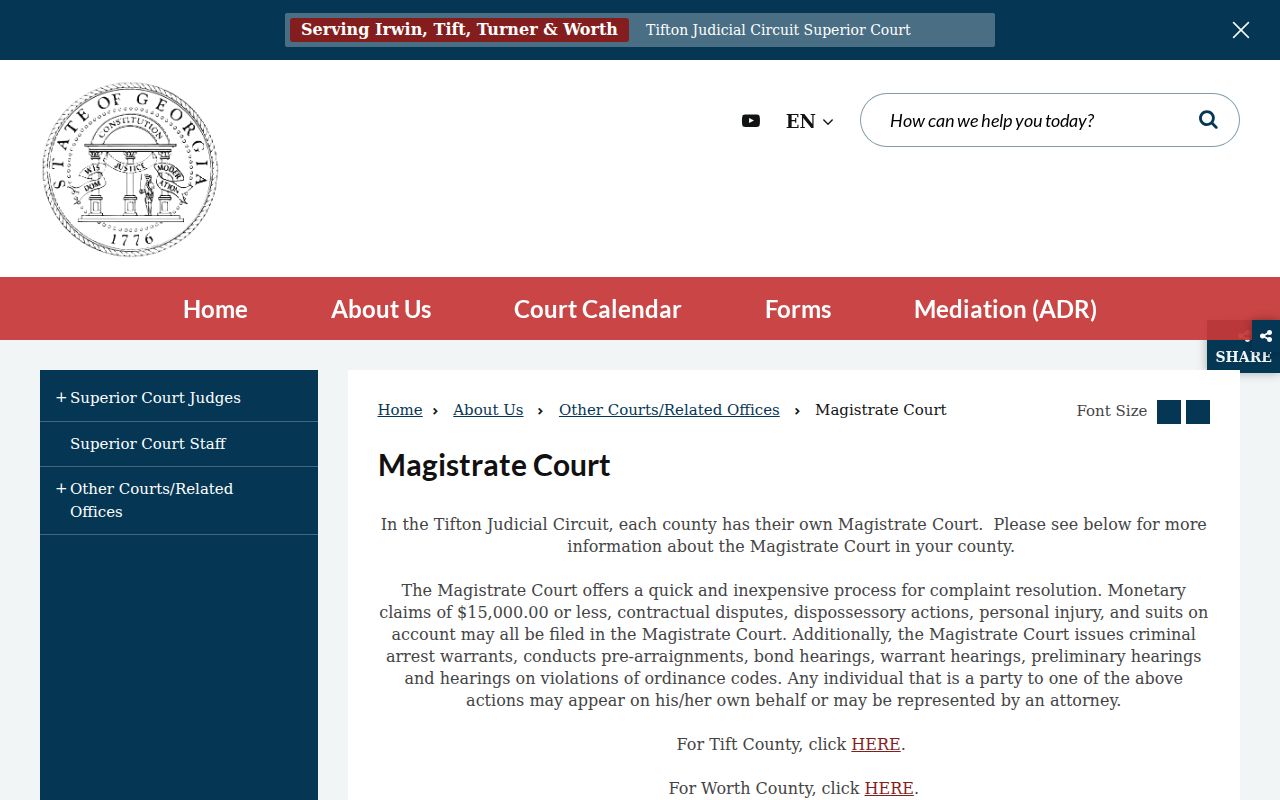
That jurisdiction summary helps you pick the right court before running a Worth County civil docket search. It matters most for smaller claims and dispossessory matters.
Hearings on the Civil Docket
A hearing date is one event in a longer civil sequence. Filing and service usually come first. Motions and their responses may then create hearings, resets, or orders. Trial and final judgment may follow. Some cases end instead by dismissal, settlement filing, default, or another order. Read the docket around the date. Do not treat one calendar item as the whole story.
Civil flow: Filing › Service › Response › Motion or Setting › Hearing or Trial › Order or Judgment › Closure.
The circuit calendar offers Worth County and judge filters, plus event search and date views. If a public calendar conflicts with another source, the court's own notice and case record control. Contact the clerk when a setting looks wrong or has moved.
Worth State Court Civil Work
Civil actions that stay outside Superior, Probate, and Juvenile Court belong to State Court. The circuit's State Court page explains this. Worth's elected Superior Court clerk also keeps the State Court records. The court class itself remains separate. That official State Court description lays out the division plainly.
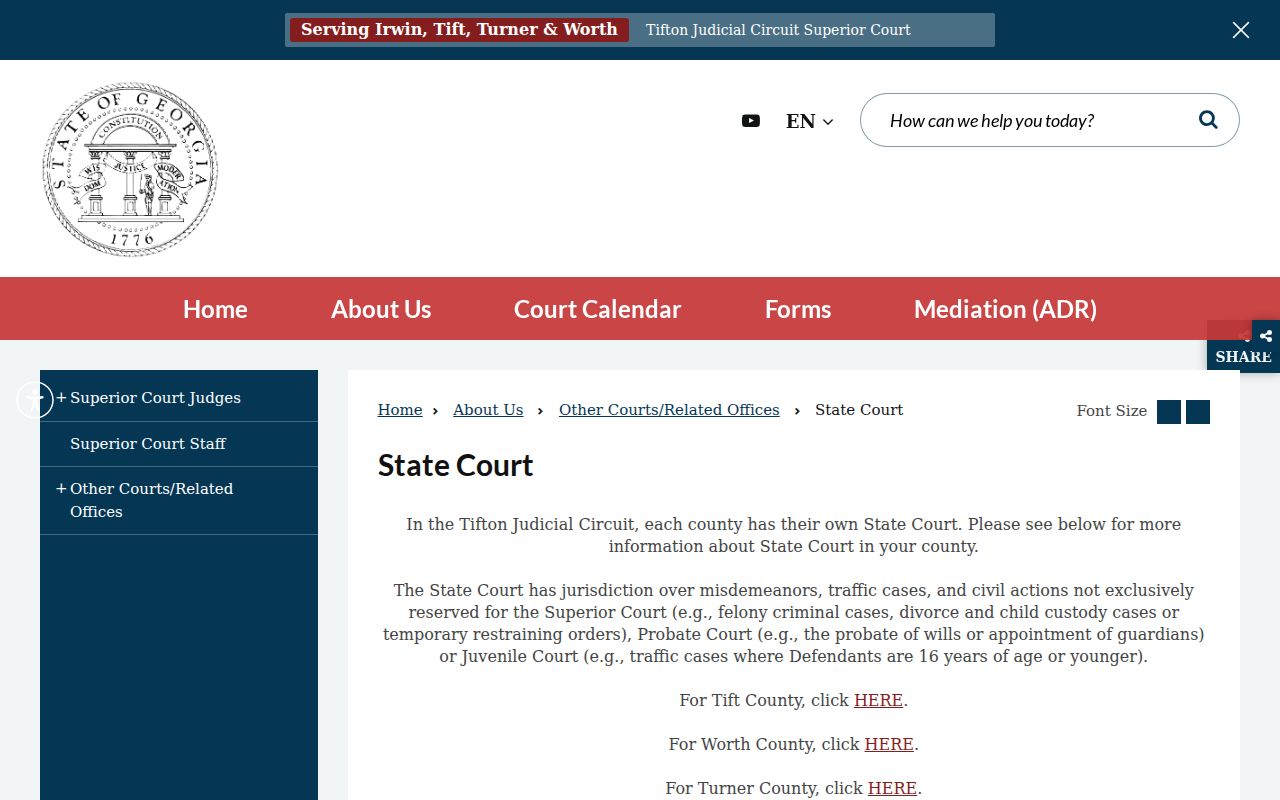
The jurisdiction page helps you confirm venue for State Court civil work. It does not search Worth County civil dockets. For covered State Court matters, PeachCourt and the local clerk are still the routes to case records and documents.
Who Can See Civil Dockets
Most Worth County civil dockets are open to the public. Access tightens for sealed exhibits, protected identifiers, and juvenile matters. It also tightens for anything a judge has ordered kept confidential. Probate and Juvenile records follow their own custody rules as well. So a public case shell can show up even when one document stays unavailable. And an online no-result may simply mean an archived paper file, not a legal bar.
Where the Open Records Act applies, the Georgia Attorney General’s guidance walks through requests under O.C.G.A. §50-18-70 et seq. Identify the custodian and the record. Keep a written copy. Ask for the cited basis if agency material is withheld. Requests aimed at the court itself may follow court rules and clerk procedure instead.
Visit the Worth clerk in Room 13, 201 N. Main St., Sylvester, GA 31791. Hours are weekdays 8:00 a.m. to 5:00 p.m. Phone (229) 776-8205 or fax (229) 776-8237. Mail goes to the same address. No local copy or certification fee is published, so request an itemized estimate before work begins.
Worth Certified Civil Orders
A docket entry, a filed image, and a certified judgment are three different products. The docket entry marks the action. The image holds the pleading or order. A certified copy carries the clerk's official certification. A calendar printout, on its own, is not certified.
When you contact Room 13, state the court, case number, party name, approximate date, the exact document, and whether you need an ordinary or certified copy. Ask about search, copy, certification, and mailing charges, since Worth County publishes no current fee table. Older files may require a date-range search. A written request can go by the clerk's fax or courthouse address once the office confirms the format it prefers.
Note: Ask for the final judgment itself when the legal text matters; the docket's short entry may not state every term.